Originally published at: Beyond Heightfields – World Machine Development Blog
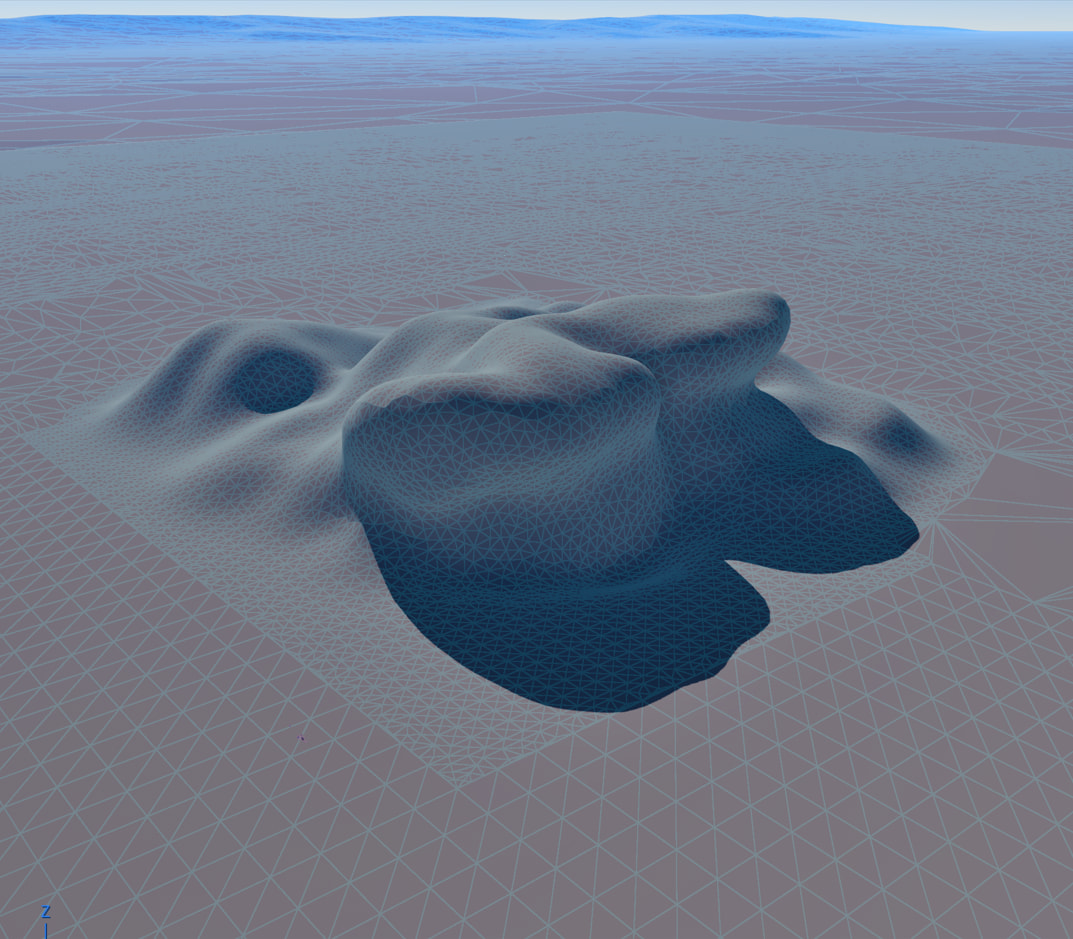
I think we need to jump straight to the marquee feature for Dragontail Peak that I’ve been working on for the last two years.  Simply this: for the first time World Machine will be able to generate and manipulate non-heightfield terrain! This is a screenshot from Dragontail Peak. This is a single terrain surface,…
10 Likes
Stoked! and mind boggling!!!
2 Likes
YOOOO
did someone notice skymap usage for background?
if it is screenshot inside wm
so skymaps is also will be a new feature?
YOOOOOOOOOO
2 Likes
I’m extremely interested to see how this affects erosion! From my understanding of vector displacement (which is extremely basic, so I’m super interested in hearing the details if I’m completely off base!) we’re mostly just considering the surface/skin of the terrain, so I’m interested to see how cutting into it can be affected. It would be extremely cool, for example, if 3D noise patterns could be used to have differing rock hardness at different depths!
Out of further curiosity, on the surface, this seems very similar to Terragen’s approach to terrain generation and manipulation. If that’s the case, does this open up the door to a more native export to Terragen for renders? Maybe not full clip networks, but perhaps a bit less restrictive than heightmap output?
3 Likes
Yes - i skipped the viewport changing coming up to go straight to VDMs, but one of them is the ability to put an HDRI skybox into the viewport! Which also replaces the prior simple sky lighting term with environment lighting from the skybox.
4 Likes
All of the VDM erosion paths are still in heavy dev work right now - they work but are not final. But yes - the VDM defines the terrain surface but not anything volumetric inside of it.
In terms of 3D structure of the underlying rock, I totally agree that it would be really cool to have 3D noise patterns for hardness/structure as the rock erodes. Some simple procedural patterning would be possible; for right now, the options are uniform or random noise.
7 Likes
 It’s absolutely amazing!
3 Likes
The next version of UE5 will feature a new mesh-based terrain system. Is this some kind of coincidence? It seems to fit very well with the new VDM terrain creation method! 
3 Likes
It is “mostly” a coincidence  But you’re right, it sure does!
3 Likes
I Won’t lie, I have recently spent days thinking about this exact thing. I have some thoughts, from quick glance it appears you are using heightfield tessellation on per mask basis on a mesh, i only ask because I’ve been trying to think of a way that i could create things like waterfalls.
does this work in a sense that you create a height field convert it to a mesh, rotate said mesh and then through tessellated heightfield change the height data as a new mesh. what if you could import a obj file and utilize the same vdm node to in theory have any shape?
1 Like
There’s an entire mesh-related cluster of changes in Dragontail that didn’t make the first pass, that I am planning on introducing in the followup. But the short answer is, yes - subject to some restrictions, you can imput a mesh and then turn it into a VDM and do whatever you want with it (and then put it back into a mesh if need be).
The limitations are topological - a VDM is topologically a square (or a disk), basically a single UV atlas. If you introduce masking, you can now have holes in the topology, but you’d have to be able to have some notion of continuity across seams to be able to truly represent any mesh. But with some limitations, a VDM or potentially a masked VDM is plenty powerful to start with.
4 Likes